Wade.
사용자가 터치 패널에 그린 그림을 물로 바닥에 출력하는 자율주행 서비스 로봇입니다. 물로 그린 그림은 시간이 지나면 증발하기 때문에 따로 지울 필요가 없습니다.
-
 2024.01
HCI Korea
Creative Award, Grand Prize
2024.01
HCI Korea
Creative Award, Grand Prize
-
 2024
IDEA International
Design Excellence Awards — Finalist
2024
IDEA International
Design Excellence Awards — Finalist
-
 2024
Red Dot Design Award
Winner — Design Concept
2024
Red Dot Design Award
Winner — Design Concept
물로 그림을 그리는 자율주행 서비스 로봇
An autonomous service robot that draws with water
WADE는 야외 바닥에 물로 그림을 그리는 자율주행 서비스 로봇입니다. 사용자가 상단 터치 패널에 그림을 그리면 로봇이 이동하면서 그 형태를 바닥에 출력합니다. 사람이 없는 구간에서는 스스로 워터드로잉을 실행해 방문객의 시선을 모읍니다. 캐리커처와 캐릭터 드로잉, 상점 홍보 문구 출력, 물 도면을 이용한 길 안내와 대기열 안내를 제공합니다. 물은 증발하기 때문에 청소가 필요하지 않고, 놀이공원과 페스티벌, 박람회처럼 사람이 오래 머무는 장소에서 활용도가 높습니다.
WADE is an autonomous service robot that draws on outdoor ground surfaces with water. When a user draws on the upper touch panel, the robot moves forward and prints that shape onto the ground. In areas where no one is present, it runs a water-drawing routine on its own to attract visitors. The service covers caricature and character drawing, printed store promotions, and wayfinding or queue information drawn in water. Because the water evaporates, no cleaning is required, which makes the robot suitable for amusement parks, festivals, and expos where visitors stay for long periods.
사람에게는 어딘가에 낙서를 하고 흔적을 남기려는 욕구가 있습니다. 그러나 공공장소에서는 남은 흔적을 다시 지워야 하기 때문에 이 욕구를 해소할 방법이 거의 없습니다. 로봇으로 그림을 출력하는 방식도 재료가 바닥에 남으면 같은 문제가 반복됩니다. WADE는 출력 재료를 물로 바꿔서 이 문제를 해결했습니다. 물로 그린 그림은 시간이 지나면 증발하기 때문에 뒷정리 없이 같은 자리에서 계속 사용할 수 있습니다.
People have an urge to scribble and leave marks. In public spaces, however, there is almost no way to act on it, because any mark left behind has to be removed. Robotic drawing systems face the same issue when the printing material stays on the ground. WADE addresses this by using water as the printing material. Water-drawn images evaporate over time, so the robot can be used repeatedly in the same location without cleanup.
구현 방식은 워터펌프와 솔레노이드 밸브를 조합한 적정기술입니다. 별도 출력 장비 없이 압력탱크로 물을 밀어내고 밸브의 개폐만 제어하기 때문에 야외에서 운용할 수 있고 유지비가 낮습니다. 여기에 틸팅과 스위블이 가능한 헤드와 표정 변화를 더해 사용자가 로봇의 상태를 확인하면서 조작하도록 했습니다. 감정 의인화 표현을 다룬 연구는 IDEA 2024 국제디자인학회에 논문으로 발표했습니다.
The system is built on appropriate technology, combining a water pump with solenoid valves. It requires no dedicated printing equipment: a pressure tank pushes the water out and only the valve opening and closing is controlled, which allows outdoor operation at a low maintenance cost. A tilting and swiveling head with changing facial expressions was added so that users can check the robot's status while operating it. The study on emotional personification was published at IDEA 2024, the International Design Conference.
헤드는 틸팅과 스위블이 가능해 사용자 방향으로 얼굴을 돌립니다. LiDAR 센서가 앞에 있는 사람을 2초간 인식하면 주행을 멈추고 얼굴을 사용자 쪽으로 회전시킵니다. 이후 상부 터치 디스플레이로 그림 입력을 받습니다. 표정 변화로 현재 동작 상태를 표시해 처음 사용하는 사람도 진행 순서를 확인할 수 있습니다.
The head tilts and swivels to turn its face toward the user. When the LiDAR sensor detects a person in front for two seconds, the robot stops driving and rotates its face toward that person. It then receives the drawing input through the upper touch display. Changes in facial expression indicate the current operating state, so first-time users can follow the sequence of steps.
사용자가 그린 그림은 세 단계를 거쳐 바닥에 출력됩니다. 먼저 화면에 입력된 그림을 행과 열로 나누어 0과 1의 데이터로 저장합니다. 이 데이터를 디지털 신호로 변환해 배열 값에 따라 솔레노이드 밸브를 제어하는 신호로 전송합니다. 로봇이 0.5m/s로 직진하는 동안 밸브가 열리고 닫히면서 입력한 그림이 바닥에 출력됩니다.
A user's drawing is printed onto the ground through three steps. The drawing entered on the screen is first divided into rows and columns and stored as data of zeros and ones. This data is digitized and transmitted as control signals that operate the solenoid valves according to the array values. While the robot drives straight at 0.5 m/s, the valves open and close and the input drawing is printed onto the ground.
터치 디스플레이 높이는 신장 120cm 어린이부터 180cm 성인, 휠체어 이용자까지 함께 사용할 수 있도록 설정했습니다. 세 조건의 도달 범위를 비교해 상단 패널의 높이를 결정했습니다. 조작 요소는 상단 한 면에 모아 한 자리에서 입력을 끝낼 수 있습니다. 이용자 연령대가 넓은 장소에서 운용하는 것을 전제로 기준을 잡았습니다.
The touch display height was set so that children from 120 cm, adults up to 180 cm, and wheelchair users can all use it. The height of the upper panel was determined by comparing the reach ranges of these three conditions. All controls are placed on a single upper face, so the input can be completed from one position. The criteria were based on operation in venues with a wide range of visitor ages.
외피는 PLA로 3D 프린팅한 뒤 조립해 제작했습니다. 내부 지지대는 알루미늄 프로파일로 짜서 외피와 부품의 하중을 프레임이 받도록 했습니다. 물 구동부와 전기부 사이는 폼렉스로 공간을 나눴습니다. 전시장에서 직접 운용하는 것을 전제로 했기 때문에 부품 교체와 정비가 가능한 조립 구조로 만들었습니다.
The outer shell was 3D printed in PLA and then assembled. The internal support structure was built from aluminium profiles so that the frame carries the load of the shell and the components. Foamex partitions separate the water drive section from the electrical section. Since the robot was intended to be operated on exhibition floors, it was built as an assembled structure that allows parts to be replaced and serviced.
물을 사용하는 로봇이기 때문에 누수가 전자부에 닿지 않도록 내부를 분리했습니다. 배선과 제어 부품은 전면에, 물탱크와 펌프 구동부는 분리된 뒤쪽 공간에 배치했습니다. 제어부에는 NI myRIO와 Lattepanda를 사용했습니다. 유체 계통은 물탱크에서 워터펌프, 압력탱크, 고전압 스위치, 릴레이, 솔레노이드 밸브, 노즐 순서로 연결됩니다. 릴레이가 전기 신호를 보내고 솔레노이드 밸브가 그 신호에 따라 열리고 닫힙니다.
Because the robot uses water, the interior was divided so that leaks cannot reach the electronics. Wiring and control components are placed at the front, while the water tank and pump drive unit sit in a separate rear compartment. NI myRIO and Lattepanda were used for control. The fluid line runs from the water tank through the water pump, pressure tank, high-voltage switch, relay, solenoid valve, and nozzle. The relay sends the electrical signal and the solenoid valve opens and closes according to that signal.
LiDAR Sensor
하부 LiDAR 센서로 전방의 사람을 인식해 주행을 멈추고 그림 입력 단계로 넘어갑니다.
The lower LiDAR sensor detects a person ahead, stops the robot, and moves to the drawing input step.
Water Level LED
몸통 뒷면 LED로 물 잔량을 확인하고, 전면 하단 커버를 열어 배터리를 교체합니다.
An LED on the rear of the body shows the remaining water, and the battery is replaced through the lower front cover.
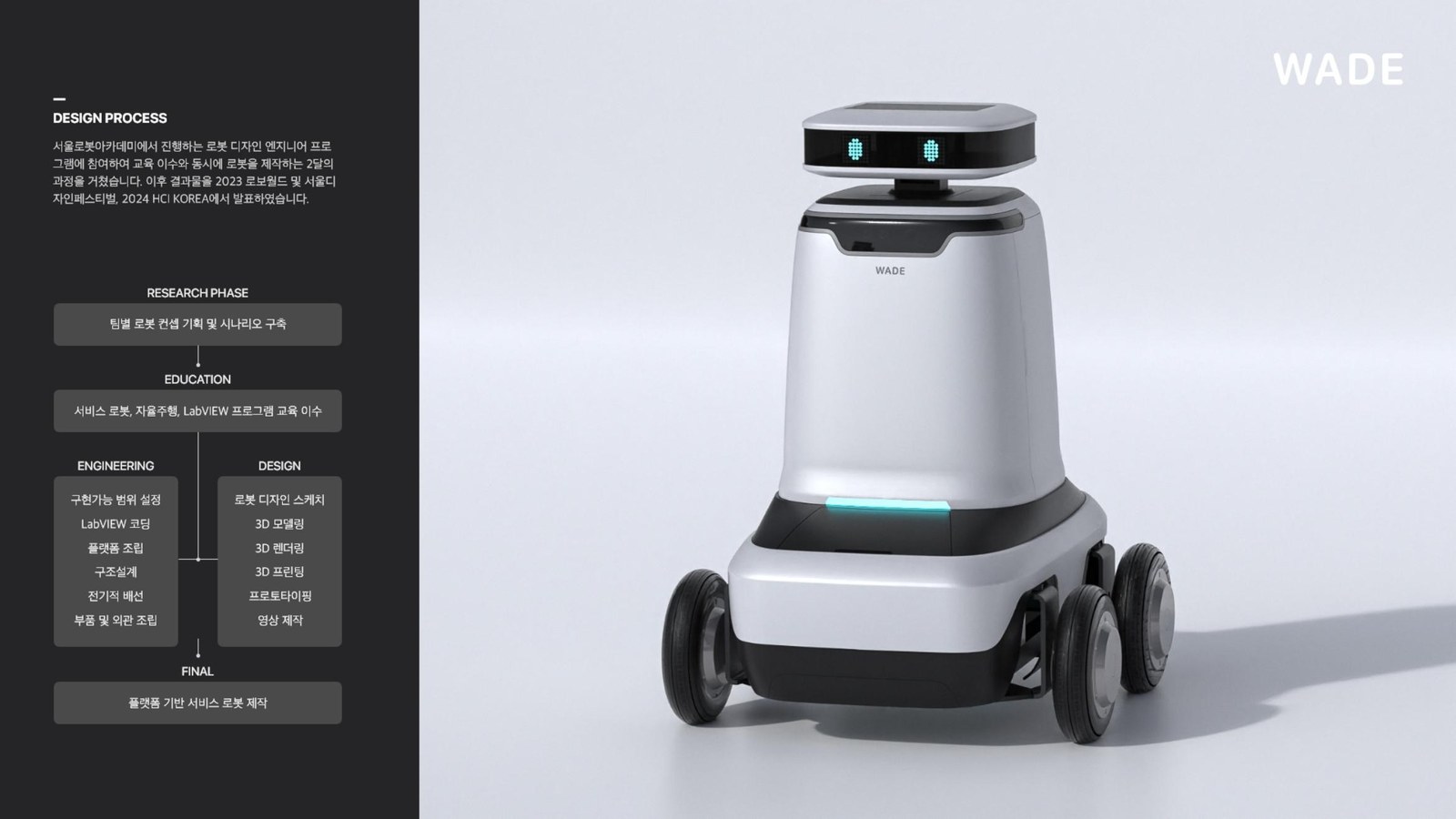
엔지니어 4명과 디자이너 1명으로 구성된 팀에서 디자인 전체를 담당했습니다. 컨셉과 시나리오를 함께 정한 뒤 서비스 로봇과 자율주행, LabVIEW 교육을 이수하고 엔지니어링과 디자인을 동시에 진행했습니다. 엔지니어링에서 구현 범위 설정과 코딩, 플랫폼 조립, 구조설계, 전기 배선을 맡는 동안 스케치와 3D 모델링, 렌더링, 3D 프린팅, 프로토타이핑, 영상 제작을 진행했습니다. 최종 결과물이 구동하는 실물이었기 때문에 치수와 배선 경로는 프로토타입을 제작해 확인하면서 수정했습니다.
In a team of four engineers and one designer, I handled the entire design track. After defining the concept and scenario together, the team completed coursework in service robotics, autonomous driving, and LabVIEW, then ran engineering and design in parallel. While engineering covered feasibility scoping, coding, platform assembly, structural design, and electrical wiring, I worked on sketching, 3D modeling, rendering, 3D printing, prototyping, and film production. Since the final deliverable was a working machine, dimensions and wiring routes were revised by building prototypes and checking them.
완성한 로봇은 2023 로보월드와 서울디자인페스티벌, 2024 HCI KOREA 전시에서 직접 운용했습니다. 운용 시나리오는 GPS 기반 자율주행, 사람을 인식해 정지하고 그림을 받는 단계, 0.5m/s로 직진하며 출력하는 단계로 구성했습니다. 현장에서는 어린이와 성인 관람객이 로봇에 그림을 그리고 출력 과정을 지켜보면서 주변에 사람이 모이는 반응을 확인했습니다. 이 프로젝트로 HCI KOREA 2024 Creative Award 최우수상을 받았습니다.
The completed robot was operated at Robot World 2023, the Seoul Design Festival, and the HCI KOREA 2024 exhibition. The operating scenario consisted of GPS-based autonomous driving, detecting a person and stopping to receive a drawing, and printing while advancing straight at 0.5 m/s. On site, children and adult visitors drew on the robot and watched the printing process, and visitors gathered around it. The project received the Creative Award, Grand Prize, at HCI KOREA 2024.